Preparation is a loop, not a pile
Most preparation for the TCF Canada begins with a pile. A folder of downloaded papers, a grammar book with a cracked spine, a playlist of French podcasts, a spreadsheet with a column for hours.
The pile grows for weeks, and it feels like progress, because every item in it took effort to collect. None of it tells you whether you are getting closer.
We think the pile is the wrong picture. Preparation that works is a loop, and every guide above is one turn of it.
- 1MeasureOne timed paper or task in each section, in exam conditions.
- 2ChooseRank the sections by how far each falls short of your target, and start with the furthest.
- 3Practise your own mistakesThe errors your corrections keep naming, drilled until they stop appearing.
- 4Rehearse the conditionsA pen and an hour for writing, a listener and a clock for speaking.
- 5Measure againCompare each section with itself, then let the result change next week’s plan.

Four results, and the weakest one decides
Start with how the exam reads you, because everything else follows from it. The TCF Canada is four tests in one sitting: listening and reading, each 39 multiple-choice questions scored out of 699, and writing and speaking, three tasks each, marked out of 20.
IRCC turns each of the four into its own NCLC level, and the Federal Skilled Worker Program asks for NCLC 7 in all four. Nothing averages. Three excellent sections and one short section is, for that programme, a miss.
Your French is not one level. Your preparation should not pretend it is.
That is why we put the study plan first. A plan that rotates the four sections evenly feels balanced, and on this exam balance is the wrong goal: until every section clears its target, the hours belong first to the one furthest from it.
And that is why tracking your progress means four numbers on two scales, each compared only with itself. A score out of 699 and a mark out of 20 do not add up to anything IRCC will ever read.
Where most preparation leaks
Candidates rarely fail for lack of effort. They fail because the effort drains away through a few familiar holes.
- Another week on the section you are already good at.
- Rereading your corrections.
- A column of hours studied.
- A good score earned with the answer key open.
- Hours sent to the section furthest from its target.
- Producing the right form from memory, days later.
- A timed result, written beside the last one.
- A full test, done cold.
The second leak is the one we find most wasteful. Every correction a candidate receives is a precise list of what to fix, and most are read once and filed away.
Twenty texts with the same mistake are twenty rehearsals of it. Our guide to the error notebook is about closing that hole: an error is done only when it stops appearing in your new texts, not when you can recite the rule.
The two things nobody rehearses
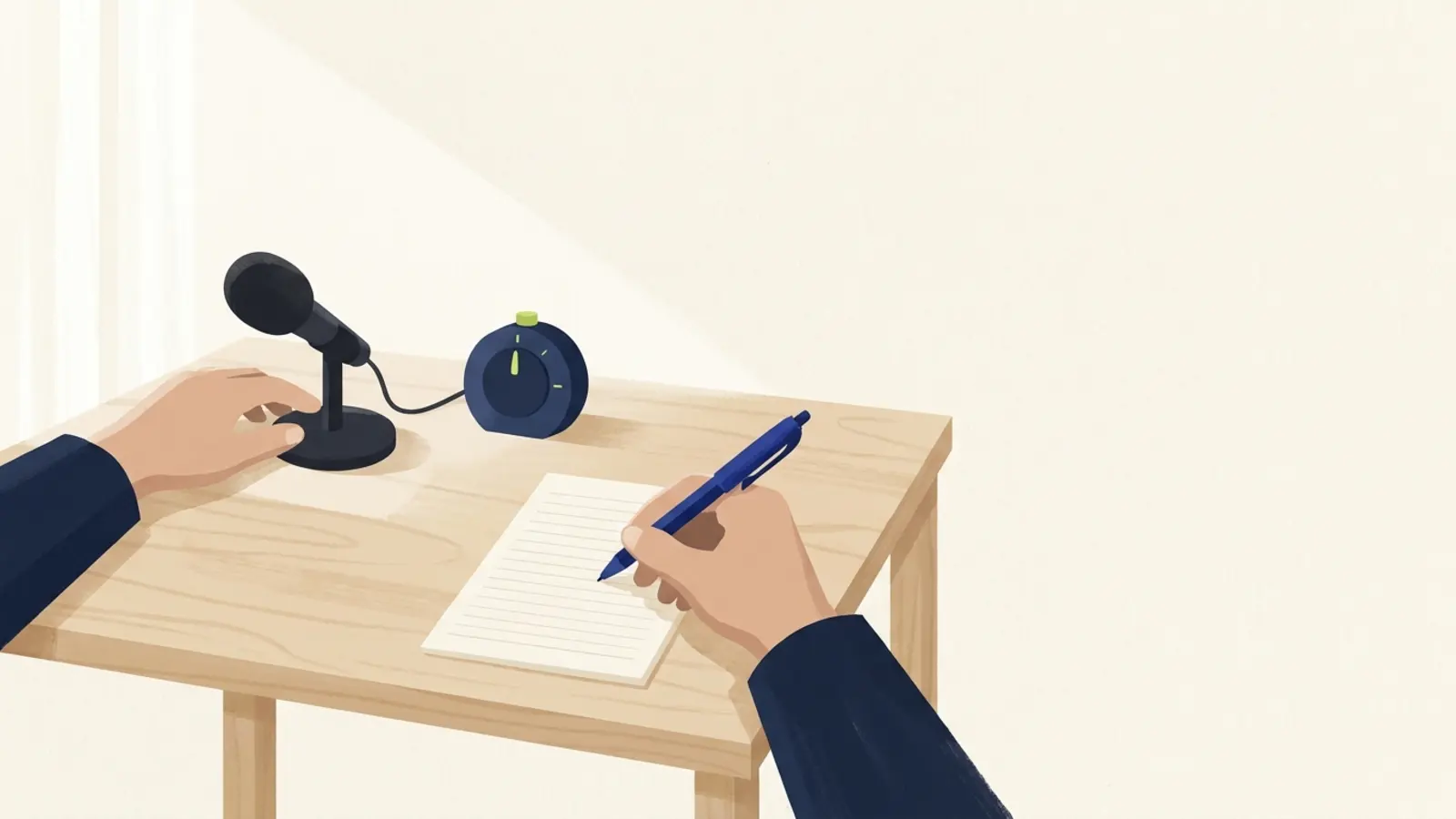
Ask candidates how they practise and you hear about apps, videos and practice questions. Almost all of it is silent, and almost all of it is typed. The exam is neither.
The hand
On the paper test, writing is an hour with a pen, and only the booklet is marked. No spellcheck, no word counter, no moving a paragraph with a keystroke.
FEI can rate a script “A1 not reached” for illegible handwriting or a task outside its word count, whatever the French. A candidate who has only ever typed is rehearsing a different exam. Our guide to writing by hand shows how to rehearse the real one.
The voice
Speaking is twelve minutes face to face with an examiner, two of them to prepare. It is the section candidates fear most and rehearse least, for a plain reason: rehearsing it takes another person, and listeners are scarce.
Recording yourself helps, but nobody interrupts a recording, and two of the three tasks are conversations. Our guide to practising with an examiner argues for giving it the repetitions and keeping people for what only people give.
Why the last weeks matter more now
Three of FEI’s rules shape how preparation should end.
- between two sittings, as many sittings as you like
- 20 days
- an attestation’s validity from the date results are issued
- 2 years
- when FEI plans to resume re-marking speaking and writing, suspended for sessions from 1 September 2026
- Autumn 2027
Read together, they say one thing: the day is final. A disappointing speaking mark can no longer be sent back for a second look, and another attempt is at least twenty days away.
So the last weeks belong to full timed tests, not new material. They train the clock and the stamina of the sitting, and they answer the question most candidates never ask: should I sit on that date at all?
The guides to the wait between sittings and the suspension of re-marking go through each rule.
Which guide to read first
You do not need all five at once. Start with the one that matches where you are stuck.
- You have no plan, or a plan from a calendar: build a study plan from your own results.
- Your corrections keep saying the same things: keep an error notebook.
- You cannot tell whether you are improving: track your progress.
- You will sit the paper test, or you only ever type: practise writing by hand.
- Speaking scares you, or you have no one to practise with: practise with an examiner.
Pick the guide for the section you have been avoiding. That is usually the one.
Where Salut Canada fits, and where it stops
Each guide ends with the way Salut Canada does that turn of the loop: a study plan that reads your results and picks the next step, a notebook that turns your errors into drills, a page that draws each section’s level over time, handwritten pages corrected, and an examiner that runs the three speaking tasks against the clock.
None of it replaces the exam. Our marks are practice feedback: Salut Canada is not FEI, and only FEI marks your TCF.
Sources
- France Éducation international (FEI), TCF Canada page: the four tests, their questions and timings, the 20 days between sittings, the attestation’s two-year validity, the suspension of re-marking from the sessions of 1 September 2026 and its planned resumption in autumn 2027.
- FEI, how a session of the TCF runs (Déroulement d’une passation du TCF): the paper booklet and the cases rated “A1 not reached”.
- FEI, the TCF candidate’s rights and duties (Droits et devoirs du candidat au TCF): texts learned by heart.
- IRCC, Express Entry: language test results.
Checked on 25 October 2026.